Papers
Abstract: We prove a quasiflat closing theorem and a coarse flat torus theorem for
hierarchically hyperbolic groups (HHGs). Namely, given an HHG \(G\), we prove
that \(G\) is hyperbolic if and only if it contains no \(\mathbb Z^2\) subgroups
and, if \(A\leq G\) is virtually \(\mathbb Z^n\), then there is an \(A\)-invariant
\(n\)-dimensional uniform quality quasiflat \(F\) such that any two points in \(F\)
are joined by a uniform-quality hierarchy path lying in \(F\). The later is a
consequence of a more detailed theorem describing a ``coarse minset'' for \(A\)
in \(G\), which has various applications, including an ascending chain condition
for virtually abelian subgroups, hierarchical quasiconvexity of highest abelian
subgroups, and some geometric control over normalisers, centralisers, and
commensurators of abelian subgroups. We use this to rule out HHG
structures for certain Coxeter groups on the basis of their affine subgroups,
and to give a new proof that virtually solvable subgroups of HHGs are virtually
abelian, which simplifies the original proof by avoiding Gromov's polynomial
growth theorem.
Abstract: For any cardinal κ ≥ 2, there is a unique complete real tree whose points all have
valence κ. In this note, we show that, when κ ≥ 3, it is necessary to assume completeness. More
precisely, we show that there exist uncountably many homogeneous incomplete real trees whose points all have
valence κ.
❯
A guide to constructing free transitive actions on median spaces, Adv. Math., 2026.
Journal version,
pdf.
Abstract: We construct large families of groups admitting free transitive actions on median spaces.
In particular, we construct groups which act freely and transitively on the complete universal real tree with
continuum valence such that any subgroup of the additive reals is realised as the stabiliser of an axis. We prove
a more precise version of this, which implies that there are \(2^{2^{\aleph_0}}\) pairwise non-isomorphic groups
which admit a free transitive action on this real tree. We also construct free transitive actions on products of
complete real trees such that any subgroup of is realised as the stabiliser of a maximal flat, and an irreducible
action on the product of two complete real trees.
To construct each of these groups, we introduce the notion of an ore: a set equipped with the structure
of a meet semilattice and a cancellative monoid with involution, which verifies some additional axioms. We show
that one can extract a group from an ore and equip this group with a left-invariant median structure.
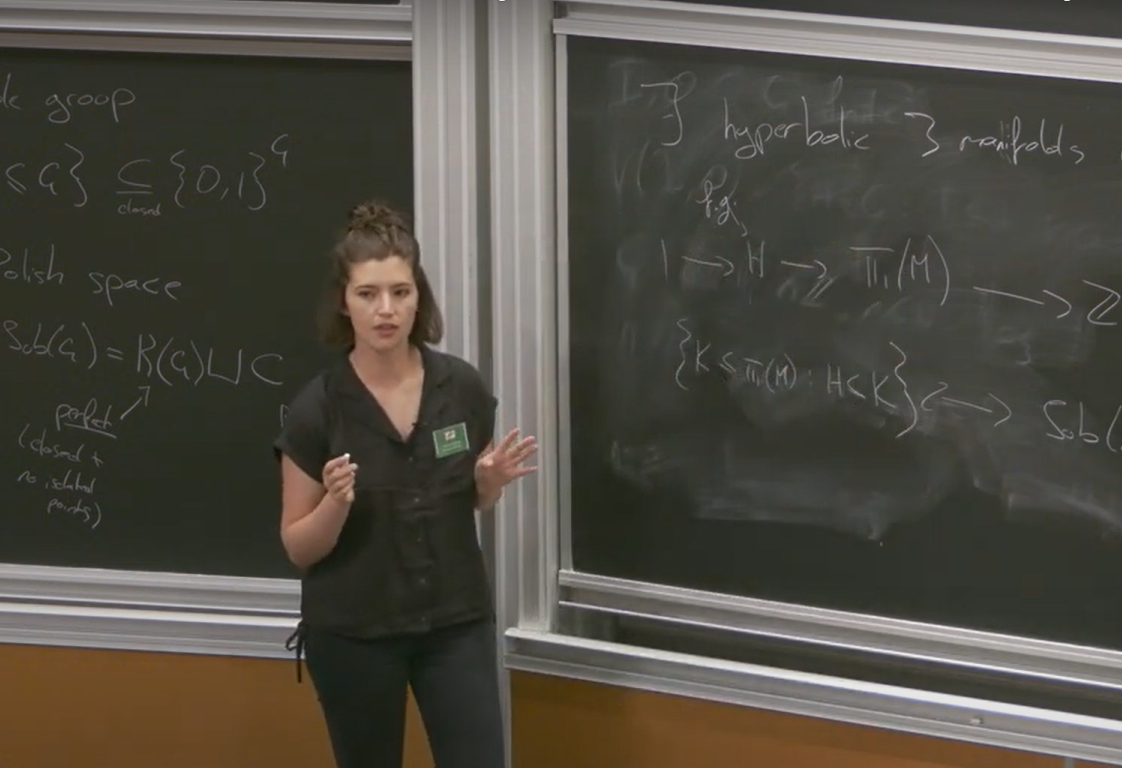
Abstract: We introduce several approaches to studying the Cantor-Bendixson decomposition of and the dynamics on the
(topological) space of subgroups for various families of countable groups. In particular, we uncover the perfect kernel and
the Cantor-Bendixson rank of the space of subgroups of many new groups, including for instance infinitely ended groups, limit
groups, hyperbolic 3-manifold groups and many graphs of groups. We also study the topological dynamics of the conjugation action
on the perfect kernel, establishing the conditions for topological transitivity and higher topological transitivity.
As an application, we obtain many new examples of groups in the class A of Glasner and Monod, i.e. admitting faithful transitive
amenable actions. This includes for example right-angled Artin groups, limit groups, finitely presented C'(1/6) small
cancellation groups, random groups at density d < 1/6, and more generally all virtually compact special groups.
❯
On subgroups with narrow Schreier graphs, Bull. Lond. Math. Soc., 2024.
Journal version,
pdf.
Abstract: We study finitely generated pairs of groups H ≤ G such that the Schreier graph of H has at least two ends and is narrow. Examples of narrow Schreier graphs include those that are quasi-isometric to finitely ended trees or have linear growth. Under this hypothesis, we show that H is a virtual fiber subgroup if and only if G contains infinitely many double cosets of H. Along the way, we prove that if a group acts essentially on a finite dimensional CAT(0) cube complex with no facing triples then it virtually surjects onto the integers with kernel commensurable to a hyperplane stabiliser.